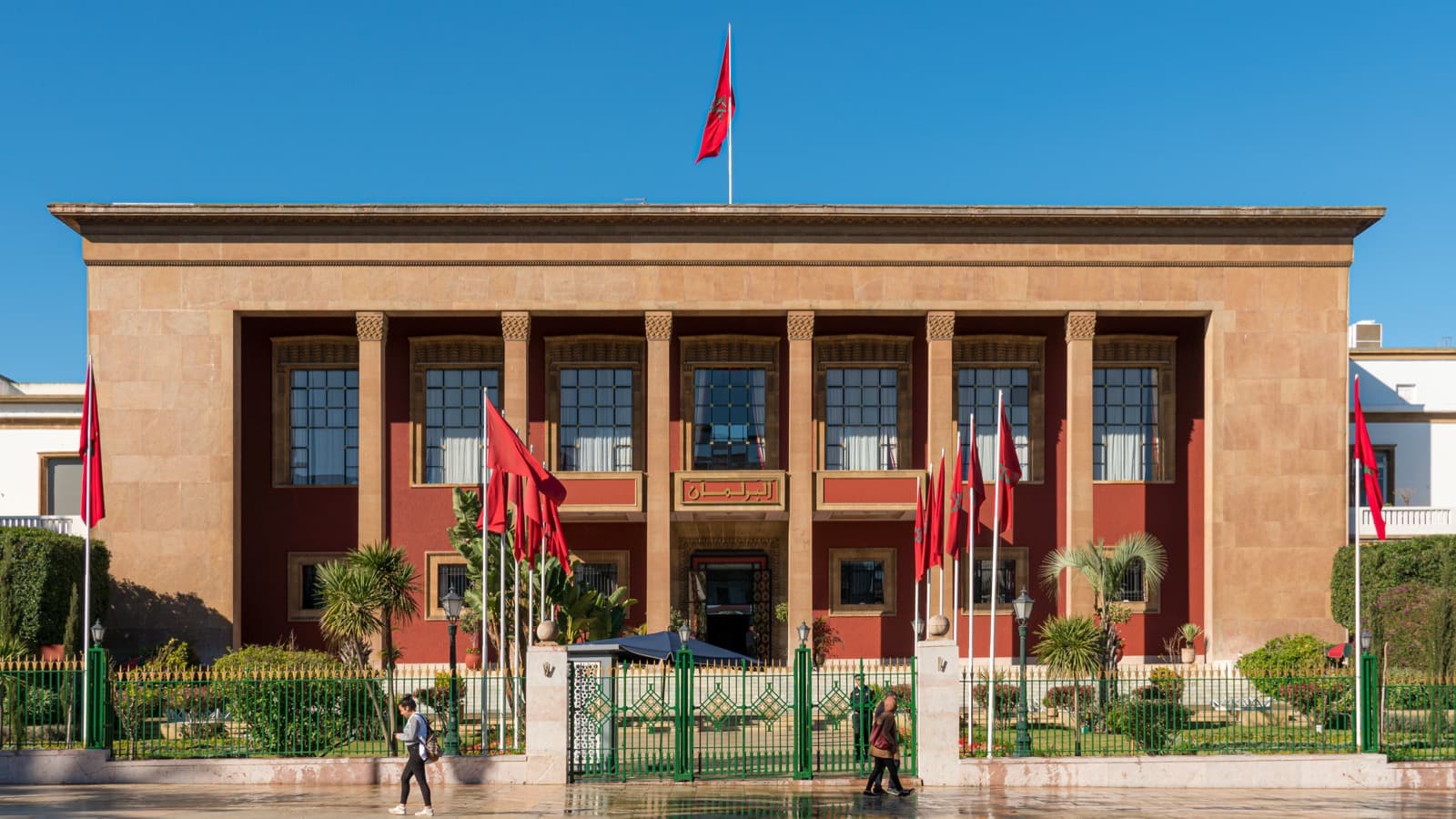
On 23 September 2026, Moroccans elected the 395 members of the House of Representatives. The verdict was unambiguous: no party would govern alone. With 97 seats, the Party of Authenticity and Modernity (PAM) came first — but it lacked 101 seats to reach the absolute majority of 198. That is the 198 equation, and solving it took three weeks.
The final results, proclaimed on 25 September, measure the landscape: 9,738,526 valid votes, fourteen parties represented, and a leading party carrying only 21.7% of the vote.
A fragmented chamber, a simple rule
The rule of the game is arithmetic: 198 of 395 seats, half plus one. Around that line, the new landscape looks like an archipelago.
| Party | % of vote | Seats | Gap to 198 |
|---|---|---|---|
| PAM | 21.7% | 97 | −101 |
| Istiqlal (PI) | 15.5% | 65 | −133 |
| RNI | 14.0% | 66 | −132 |
| PJD | 14.6% | 54 | −144 |
| MP | 7.2% | 29 | −169 |
| USFP | 6.8% | 26 | −172 |
| PPS | 5.0% | 19 | −179 |
| UC | 4.6% | 17 | −181 |
| MDS | 3.6% | 8 | −190 |
| FGD | 2.8% | 8 | −190 |
| Others (FFD, PE, ND, PUD) | 2.2% | 6 | −192 |
| Total | 100% | 395 | — |
A revealing detail: Istiqlal places second in votes (15.5%) but third in seats (65), overtaken by the RNI (66) on fewer ballots — the constituency map at work. And PAM's win was built, not inherited: the party rose from 87 seats in 2021 to 97 this time, boosted in part by the high-profile recruitment of Fouzi Lekjaa, the football federation chief who now runs the Finance Ministry.
No top duo suffices, and adding up the losers does not help either: RNI + Istiqlal + PJD = 185 seats, still under the bar. Without PAM, governing required at least five parties.
The deal that was struck
On 12 October, four parties announced a majority agreement: PAM (97), Istiqlal (65), USFP (26) and PPS (19). Total: 207 seats, nine above the threshold.
A four-party coalition, 207 seats, nine to spare: strong enough to legislate, narrow enough that every partner counts.
The spoils followed the arithmetic. Of the government's posts, PAM took ten, Istiqlal six, USFP five, PPS three — with seven portfolios going to figures without a party badge. The government sworn in on 16 October maps the balance: Lekjaa at Economy and Finance for PAM, Nizar Baraka at Equipment for Istiqlal, party leader Nabil Benabdallah in the cabinet for PPS, while the "sovereign" ministries — Bourita at Foreign Affairs, Laftit at Interior — stay above the party fray.
The arithmetic of every combination
| Combination | Total | Status |
|---|---|---|
| PAM + Istiqlal + USFP + PPS | 207 | ✅ Majority formed |
| PAM + RNI + Istiqlal | 228 | ❌ Talks closed |
| PAM + RNI + PI + MP | 257 | ❌ Floated, not retained |
| PAM + RNI | 163 | ❌ Under the bar |
| PAM + Istiqlal | 162 | ❌ Under the bar |
| RNI + Istiqlal + PJD | 185 | ❌ Without PAM, not enough |
Read that table twice: even the broadest alliance of the three big losers caps at 185. In the 198 equation, PAM was the mandatory variable.
The majorities that never happened
History remembers the coalitions that fail. Three scenarios seriously existed:
- The PAM–RNI–PI rerun (228 seats) — the easy option, dropped when talks over the share of portfolios did not conclude with the RNI.
- Opening to the PJD — Abdelilah Benkirane's party, buoyed by its rebound (13 → 54 seats), declined any participation, choosing opposition on principle.
- The grand alliance PAM–RNI–PI–MP (257 seats) — floated for a time, it would have sidelined the left and tilted the chamber right.
The RNI, for its part, has settled into the role of chief critic — denouncing the new cabinet as "Akhannouch's government in disguise", a line designed for the campaign to come. You can replay every combination yourself in the coalition simulator.
The 22 October test: 204–127
Forming a majority is one thing; holding it on a recorded vote is another. Under Article 88 of the Constitution, the government had to present its programme to both houses and win an absolute majority in the lower chamber.
The result, on 22 October: 204 votes for, 127 against, with 331 of 395 deputies casting ballots. The government crossed its first constitutional threshold with room to spare — but the numbers repay a closer read:
- 204 of 207: at least three coalition deputies were absent or broke ranks on day one — the nine-seat margin already eroding at the edges.
- 127 against: the opposition voted close to its full weight (RNI 66 + PJD 54 = 120, plus allies), showing it can mobilize a disciplined bloc.
- 64 absent or abstaining: more than one deputy in six stayed home — the diffuse centre of the chamber that both sides will court vote by vote.
What 207 means for the legislature
Nine seats of margin is thin — and the confidence vote just proved it. Three consequences follow:
- Every deputy counts. A rebellion of a dozen backbenchers can sink a bill — the 204–127 vote showed slippage starts with three.
- Party discipline becomes issue #1. The four parties must vote together on key texts — even when their bases diverge.
- The stakes are high and dated. This legislature oversees the final stretch of Morocco's 2030 World Cup preparations — a $20-billion programme co-hosted with Portugal and Spain that no majority can afford to fumble.
The 198 equation found its answer on 12 October; its first live test passed on 22 October. The real unknown remains: how long 207 hold together — now measured one vote at a time.
Updated on 27 October 2026
- #coalition
- #majority
- #pam
- #istiqlal
- #usfp
- #pps
Frequently asked questions
Why is the absolute majority 198 seats?
The House of Representatives has 395 seats. An absolute majority — half plus one — is therefore 198 seats. That is the threshold for passing ordinary bills without depending on the opposition.
Why does the coalition hold 207 seats and not 228?
The outgoing trio PAM–RNI–Istiqlal totalled 228 seats on paper, but talks over the share of portfolios did not conclude with the RNI. The PAM–Istiqlal–USFP–PPS quartet (207 seats) was preferred: politically more coherent, with nine seats above the threshold.
Did the government win its confidence vote?
Yes. On 22 October 2026, under Article 88 of the Constitution, the House of Representatives adopted the government programme with 204 votes in favour and 127 against (331 votes cast) — completing the investiture.
Can the opposition bring down the government?
In theory, yes, through a censure motion requiring a qualified majority. But the RNI (66), the PJD (54) and their potential allies together hold about 185 seats — under half the Chamber. Toppling the government would require defections from the majority.