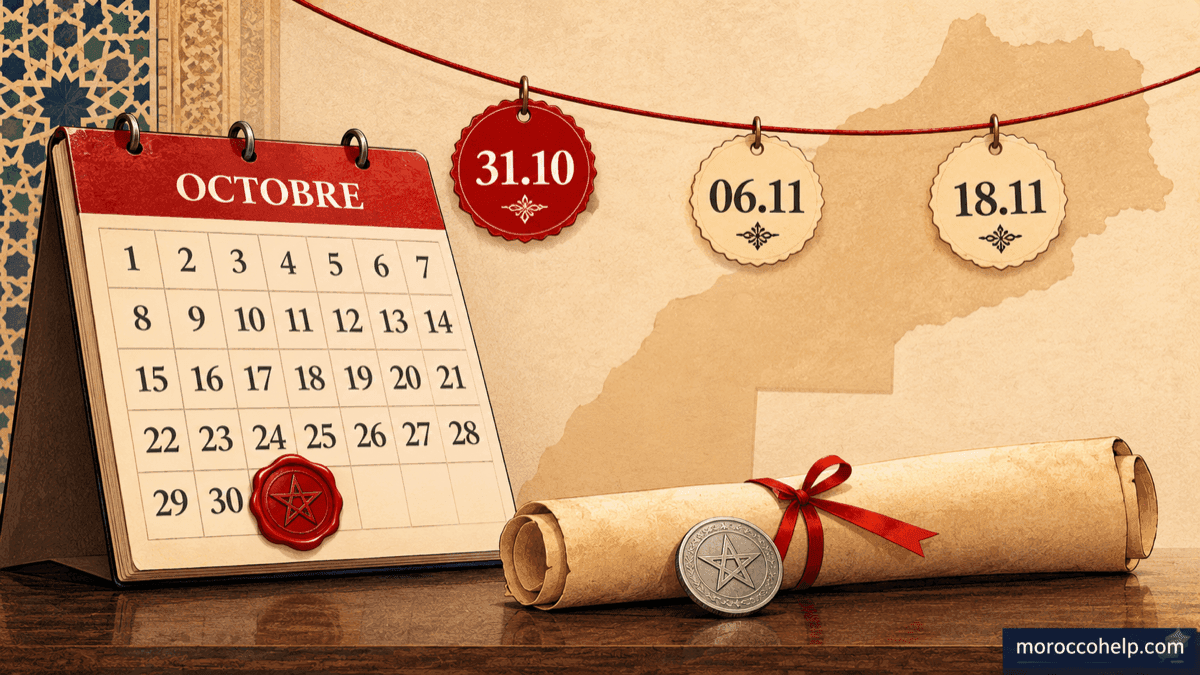
Morocco's national calendar pauses today for a holiday that did not exist two years ago, on a date that was an ordinary Thursday within living memory. This is the first edition of Aid Al Wahda, Unity Day: the 31st of October, proclaimed by royal decision, inscribed between the anniversaries that carry the kingdom's autumn - and celebrated this year under a sky no scriptwriter would have dared to write.
Why October 31
The date is an anniversary. On 31 October 2025, the UN Security Council adopted Resolution 2797, the text that, for the first time, wrote Morocco's autonomy proposal into international law as the basis for negotiations over the Sahara, within the framework of Moroccan sovereignty. Four days later, on 4 November 2025, the Royal Office published the proclamation: "It has been decided to proclaim October 31 of each year as a national holiday and an occasion on which His Majesty the King grants His pardon."
The statement explained the naming. The King, it said, "has graciously named this national holiday 'Aid Al Wahda', with all that it entails in terms of meanings and references to the national unity and the unshakable territorial integrity of the Kingdom" - a uniting occasion for "attachment to the Kingdom's national sacred values and its legitimate rights".
A new architecture for royal speeches
The same proclamation quietly reorganized an older tradition. Henceforth, the statement announced, the Royal Speech would be delivered on two fixed occasions: the Throne Day speech (30 July) and the speech at the opening of Parliament. The King "reserves the right to address His faithful people at any time" he deems appropriate - but the automatic occasions shrink to two.
The first consequence was immediate: the 50th anniversary of the Green March, later that November, was celebrated as planned, but without a speech to the nation. For a monarchy whose rhetorical calendar has long structured political time, this was not a detail. It concentrated the sovereign's set-piece addresses on the two moments that map onto his constitutional role - the state's day, and the legislature's year.
The first edition, by the numbers
The inaugural Unity Day arrived with its institutions already in place.
The royal pardon. The Ministry of Justice announced that 907 people benefited: 613 detained, of whom 17 were released outright, 595 had sentences reduced and one had a life sentence commuted to a fixed term; and 294 at liberty, including 202 whose fines were cancelled outright. The pardon, customary on national and religious holidays, is now constitutionally anchored to this date.
A collector coin. Bank Al-Maghrib issued a 250-dirham silver coin to mark the first anniversary - the state's traditional gesture when a date is promoted from news to heritage.
The political class. The majority PAM's political bureau, meeting on 26 October, formally welcomed "Morocco's first National Unity Day", tying it to the diplomatic developments of Resolution 2797. Expect every party to do the same each year; the date is now part of the liturgy all sides must observe.
An unplanned epigraph. Hours before the holiday began, the Security Council deadlocked over MINURSO's mandate, and the Royal Office framed the mission's imminent departure from the southern provinces as the development with which the first Unity Day coincides. Our analysis of that announcement covers it in full; for the holiday itself, the effect is a first edition that doubles as a turning point.
The national season
The new date slots into a deliberate sequence. Six days later comes the anniversary of the Green March (6 November); eighteen days after that, Independence Day (18 November). Together they form a three-week national season - Unity Day for the territory's present, the Green March for its recovery, Independence Day for the state itself.
It is the first addition to the national holiday calendar since the Amazigh New Year (14 January) became an official national holiday in 2024 - and, unlike that addition, which recognized an existing popular celebration, Unity Day creates a commemoration from scratch, attached to a specific diplomatic text.
What the holiday does
A national holiday is a political instrument like any other, and this one does three things at once. It converts a diplomatic result into a recurring civic ritual - schools, administrations and broadcasts will repeat its meanings annually, long after the resolution itself is history. It fixes the Sahara file at the center of the national narrative rather than in the compartment of foreign policy. And it gives the crown a new annual gesture - the pardon - precisely calibrated to soften the symbolism with mercy.
For the government of Fatima Ezzahra El Mansouri, the first Unity Day is also a first test of stewardship: the government that owns the development budgets of the southern provinces now owns the holiday that celebrates them. The elections archive explains the majority that will vote on both.
Read next: The end of MINURSO - 35 years, two vetoes, one closed chapter.
Updated on 31 October 2026
- #unity day
- #aid al wahda
- #national symbols
- #royal pardon
- #resolution 2797
- #sahara
Frequently asked questions
What is Aid Al Wahda?
Unity Day is Morocco's newest national holiday, proclaimed by the Royal Office on 4 November 2025 and observed every 31 October. It commemorates the adoption, on 31 October 2025, of UN Security Council Resolution 2797, which made Morocco's autonomy proposal the basis for negotiations over the Sahara. The day is also an annual occasion on which the King grants royal pardons.
Why was October 31 chosen?
Because Resolution 2797 was adopted on that date in 2025. The Royal Office described it at the proclamation as a 'historic turning point' in the national cause, one that justified fixing the date permanently on the kingdom's calendar as a symbol of national unity and territorial integrity.
What happened on the first Unity Day?
King Mohammed VI granted a royal pardon to 907 people, 613 of them detained and 294 at liberty. Bank Al-Maghrib issued a 250-dirham silver collector coin. And on the same evening, the Royal Office announced that MINURSO's presence in the southern provinces should end in the coming days after the Security Council failed to renew the mission's mandate.