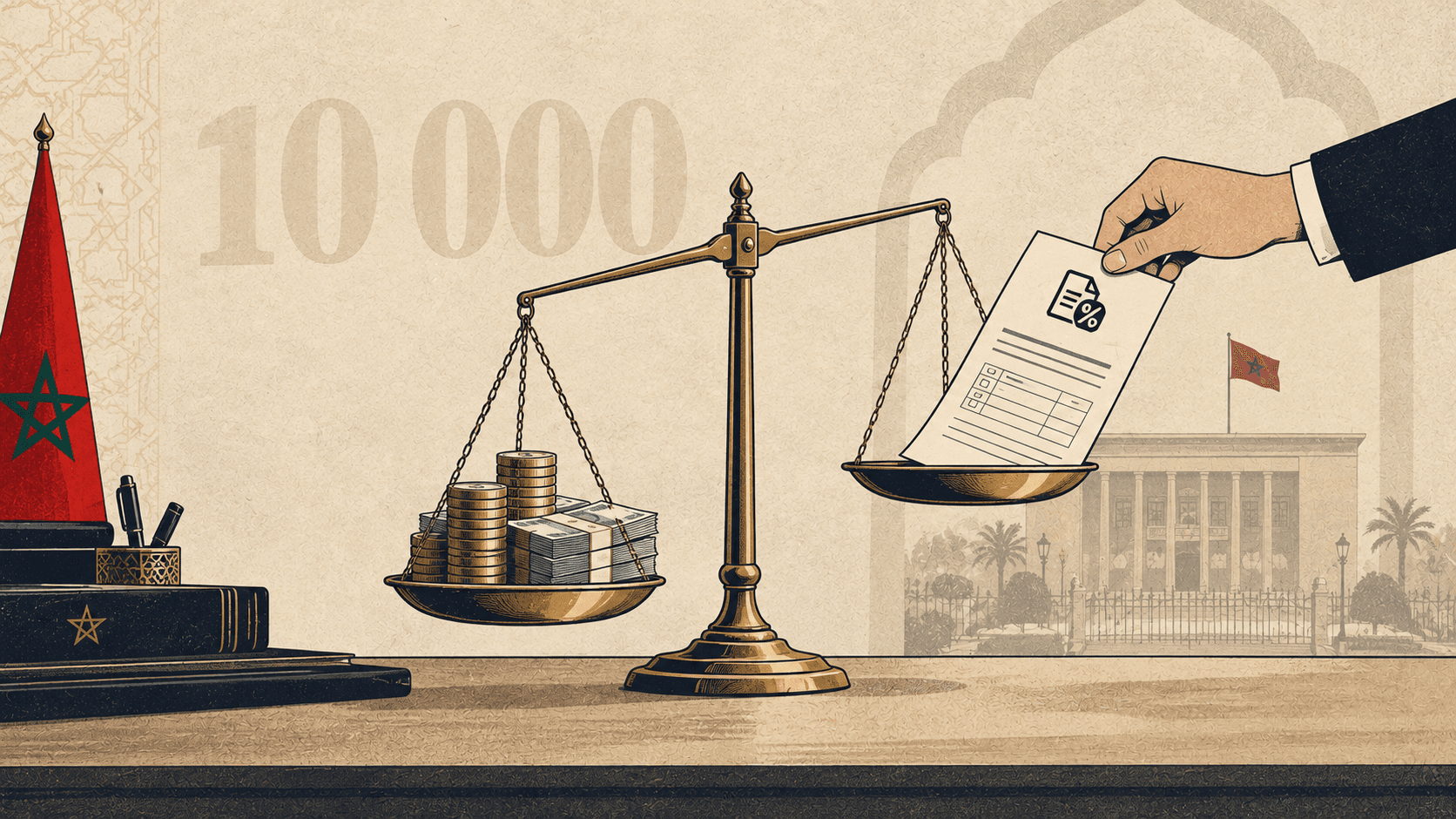
Six days after winning Parliament's confidence by 204 votes to 127, the El Mansouri government put its first big number on the table. Presenting the 2027 draft budget to the Chamber on Friday 23 October, Finance Minister Fouzi Lekjaa confirmed the measure the majority had campaigned on: Moroccans earning less than 10,000 dirhams a month net will stop paying income tax.
The overhaul, phased between 2027 and 2031, goes further than a single exemption. It rewrites the architecture of the tax itself - fewer brackets, lower rates, a higher threshold - and it arrives with a price tag of 5.5 billion dirhams attached. For a cabinet invested on 22 October with a nine-seat majority, the finance bill is the first test of whether the coalition's arithmetic holds when the votes are about money rather than confidence.
What changes, line by line
Three figures carry the reform.
The exemption floor. Net salaries below MAD 10,000 per month leave the income-tax base entirely. In a country where the median wage sits well under that line, the measure is less a tax tweak than a transfer: most employees covered are expected to take home around 500 dirhams more each month in 2027.
The brackets. The five existing income-tax brackets collapse into three - 10%, 20% and 30% - and the top marginal rate drops from 37% to 30%. The simplification matters politically as much as fiscally: a three-bracket scale is easy to explain on a doorstep, which is precisely where the majority's parties will defend it.
The threshold. The annual tax-free net income allowance rises from MAD 40,000 to MAD 60,000, pulling a further band of low earners out of the net before the exemption floor even applies.
Put together, the government says 87% of taxpayers will owe no income tax once the phases land. Nine in ten Moroccans who file, outside the system entirely.
Why 2027 - and why now
The timing is the message. The September election was fought on purchasing power: a 38% turnout, a PJD rebound built on the cost of living, and Gen Z protests the year before had already moved wages and prices to the centre of politics. The new majority's answer, six weeks into its mandate, is to put cash back in payslips before its first anniversary.
It is also Lekjaa's budget in a precise sense. The Finance Minister joined PAM's political bureau only in July, was talked about as an alternative head of government in September, and took the Economy and Finance portfolio in October - the most watched seat in the cabinet. The tax cut is his opening statement: an immediately readable measure that lands before the regional and municipal cycles, and before the World Cup co-hosting spotlight of 2030 sharpens every comparison with neighbours.
Where the money goes - and where it comes from
The 2027 bill is not only a tax cut. The same week's documents sketch the rest of the ledger: 34,454 new government posts, with the Interior ministry taking the lion's share; a heavier tax on the bumper profits of fuel distributors; and a capital budget weighted toward dams, desalination and irrigation - the water infrastructure that successive drought years have turned into the kingdom's most measured obsession.
The financing logic is classic Lekjaa: broaden relief at the bottom, extract more from concentrated windfalls, and lean on the investment pipeline to keep growth - and therefore revenue - moving. Whether the arithmetic survives contact with a volatile global economy is the bet inside the bet. The 5.5-billion cost is booked against forecasts, and forecasts have been humbled before.
The parliamentary path
The bill now enters the committee grinder with a majority that is thinner than it looks: 207 seats, nine above the threshold, and - as the confidence vote showed - three coalition deputies already willing to abstain or worse. Budget votes are where majorities learn their true size.
Watch four things. The timeline: the finance law must pass before 31 December or the state reverts to provisional twelfths - an institutional clock that usually disciplines rebellion. The amendments: opposition parties, PJD first, will bid to raise the exemption floor further and dare the majority to vote against it. The UEMF-adjacent social measures: subsidies and health coverage often get trimmed in committee to fund tax relief. And the RNI's position: the ex-ruling party, now leading the opposition with 66 seats, has every incentive to vote against the first budget of the coalition that excluded it - while its own business base quietly enjoys the lower top rate.
The bigger picture
One budget does not make a mandate. But first budgets reveal priorities in a way later ones never do, and this one says three things clearly: purchasing power first, water infrastructure second, and a state that still hires - tens of thousands of posts - even as it lightens the taxman's hand.
For the El Mansouri government, the risk is symmetry. If the reform is felt in payslips by spring, the majority can claim the mandate's first promise kept. If inflation eats the 500 dirhams before they are noticed, the opposition has its storyline ready-made. Between those outcomes sits a coalition with nine votes to spare, a finance minister with a reputation for numbers, and a tax scale about to become the most-discussed arithmetic in Morocco - after 198.
Track the majority that must pass this bill on the government page, and explore every seat it rests on in the results.
Updated on 28 October 2026
- #budget 2027
- #income tax
- #lekjaa
- #finance bill
- #government
- #purchasing power
Frequently asked questions
Who stops paying income tax under the 2027 reform?
Moroccans earning less than MAD 10,000 per month after deductions become fully exempt. According to the government, 87% of taxpayers will pay no income tax once the reform is fully phased in between 2027 and 2031.
How do the new tax brackets work?
The five existing brackets are reduced to three, with rates of 10%, 20% and 30%. The top marginal rate falls from 37% to 30%, and the annual tax-free threshold rises from MAD 40,000 to MAD 60,000.
What does the reform cost the state?
The Treasury puts the cost at MAD 5.5 billion. Most employees covered by the first phase are expected to take home around MAD 500 more per month in 2027.