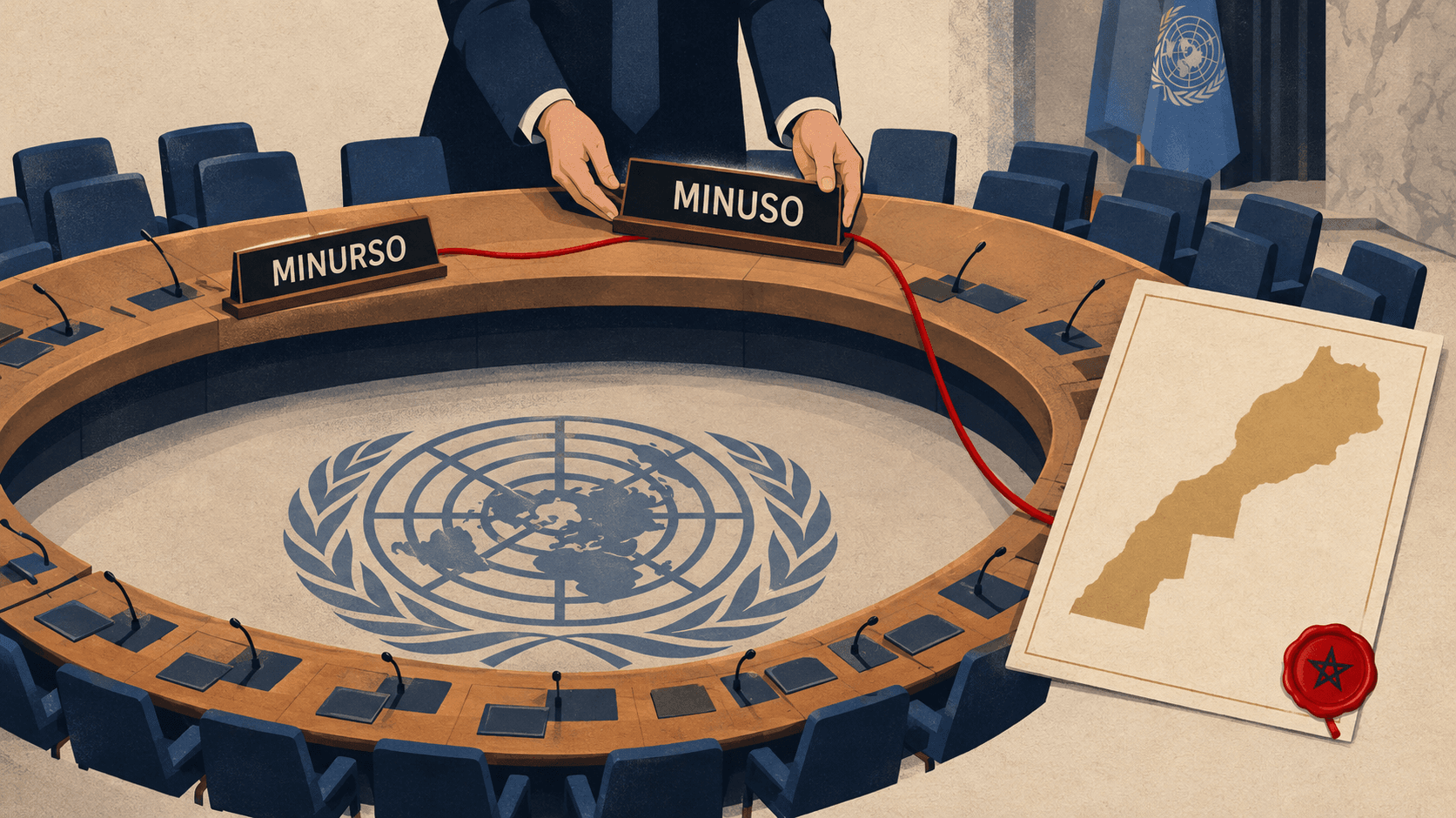
The annual ritual at the Security Council usually moves a few adjectives. This year it moves an era. Between the American "zero draft" circulated in early October and the revised text that emerged from closed-door negotiations, one thing never changed: Morocco's autonomy proposal is written in as the sole basis for negotiations, and the word "referendum" is being removed from the United Nations mission itself.
The Council is expected to vote before the current mandate of MINURSO - the Mission for the Referendum in Western Sahara, created in 1991 to organise a vote that was never held - expires on 31 October. Foreign Minister Nasser Bourita carried Morocco's position to the General Assembly in September: the file has entered a new phase, with the autonomy proposal at the centre of renewed negotiations.
What the two drafts agree on
Start with what survived every round of negotiation, because it is the heart of the text.
Autonomy as the sole basis. Both drafts require the parties to negotiate "on the basis of Morocco's autonomy proposal as the sole basis" and to submit formal responses within that framework. Not a basis - the basis. After three decades in which the autonomy plan was one option among several, this is the substantive break.
The end of the referendum mission. MINURSO becomes MINUSO - the United Nations Mission in Western Sahara. The original draft had proposed an even more explicit title, "United Nations Mission for a Political Solution in Western Sahara"; the revised version settles for the shorter name. In either case, the referendum disappears from the mission's name and from its mandate, taking effect on 1 November 2026.
Tindouf, word for word. The requirement for the UN refugee agency to "complete the registration of the refugee population in the Tindouf area within six months" survives untouched - in a file where Morocco has long argued the camps' population figures are unverifiable, this is the second quiet revolution in the text.
Washington's ownership. Both versions acknowledge "President Trump's leadership in resolving the conflict", reaffirm support for the Secretary-General, his Personal Envoy Staffan de Mistura, and the three rounds of direct talks held in Washington and Madrid.
What changed in the revision
The revised draft makes concessions on tone and timetable - not on direction.
The original text called genuine autonomy under Moroccan sovereignty "the only viable solution". The revision prefers "the most feasible solution". The principle of self-determination, which the zero draft had relegated to the preamble, returns to the operative paragraphs. Diplomats will argue about the difference; the destination does not move.
The real changes concern the mission's future. The zero draft would have ended the peacekeeping mandate on 30 April 2027, converted MINUSO into a special political mission from 1 May, and cut uniformed personnel by at least half by 31 January 2027. The revision drops all of that: the existing mandate simply runs to 31 October 2027, the immediate troop cuts disappear, and the Secretary-General is asked instead for detailed proposals by 30 January 2027, with the Council deciding the mission's future "in light of" those proposals and the political process.
The tone softens elsewhere too. The standalone condemnation of the Polisario's 5 May 2026 attack on Es-Smara is folded into a broader call for an end to hostilities, and the threat of "further measures" against parties that fail to engage has been deleted. Whether that softening wins the votes of the Council's sceptics is the question of the week.
Why the Sahrawi Movement for Peace matters now
A resolution is one thing; the political field is another. The rise of the Sahrawi Movement for Peace - which rejects the Polisario's armed path and is emerging as a serious rival for influence in the camps - is part of the same picture. If the Council's text makes negotiations on autonomy the only track, the movement offers a Sahrawi interlocutor built for exactly that track.
For Algeria, which backs the Polisario, the text reads as a strategic defeat brokered in Washington. The diplomacy of the coming weeks - including Morocco's courtship of wavering Council members such as Mexico - will determine how lonely the "no" votes are.
The view from Rabat
For Morocco, the resolution caps a decade of accumulation: the 2020 American recognition of Moroccan sovereignty, the wave of consular openings in Laâyoune and Dakhla, and now a Security Council text that names autonomy as the destination. It also lands, deliberately or not, in the first month of the El Mansouri government - a cabinet sworn in on 16 October and invested by Parliament on 22 October with 204 votes.
The file remains royal above all: the King sets Sahara policy, and Foreign Minister Bourita executes it. But the new majority will own the follow-through - the development budgets for the southern provinces, the parliamentary backing for any agreement, and the communications battle that will accompany the vote's aftermath.
What to watch on 31 October
Three markers will tell us whether this is a turn or a rupture. The vote count: does the resolution pass with the thirteen, fourteen votes that recent Sahara texts have gathered, or by a thinner margin that signals unresolved resistance? The Russian and Chinese explanations of position, which will frame how Moscow and Beijing behave when the strategic review returns in January. And the reaction in the camps, where the Polisario leadership must choose between a text that forecloses its maximal demand and a negotiation it has already refused to join.
One era - the referendum era, kept formally alive since 1991 - is ending. What replaces it is written down. Who accepts it is not.
The portal's government page tracks the cabinet that will carry this file, and the results archive holds the electoral arithmetic behind it.
Updated on 28 October 2026
- #sahara
- #united nations
- #security council
- #minuso
- #autonomy
- #diplomacy
Frequently asked questions
What changes for MINURSO under the new resolution?
The mission would be renamed MINUSO - the United Nations Mission in Western Sahara - with the word 'referendum' removed from both its name and its mandate. Under the revised draft, the new name takes effect on 1 November 2026 and the existing mandate runs until 31 October 2027.
Does the resolution still mention self-determination?
Yes. The revised text restores the principle of self-determination to the preamble and the operative paragraphs. In substance this does not change the direction of the text: autonomy under Moroccan sovereignty remains the sole basis for negotiations, presented as itself a form of self-determination.
When will the Security Council vote?
The vote is expected before the current MINURSO mandate expires on 31 October 2026. The revised draft circulated after closed-door negotiations led by the United States.