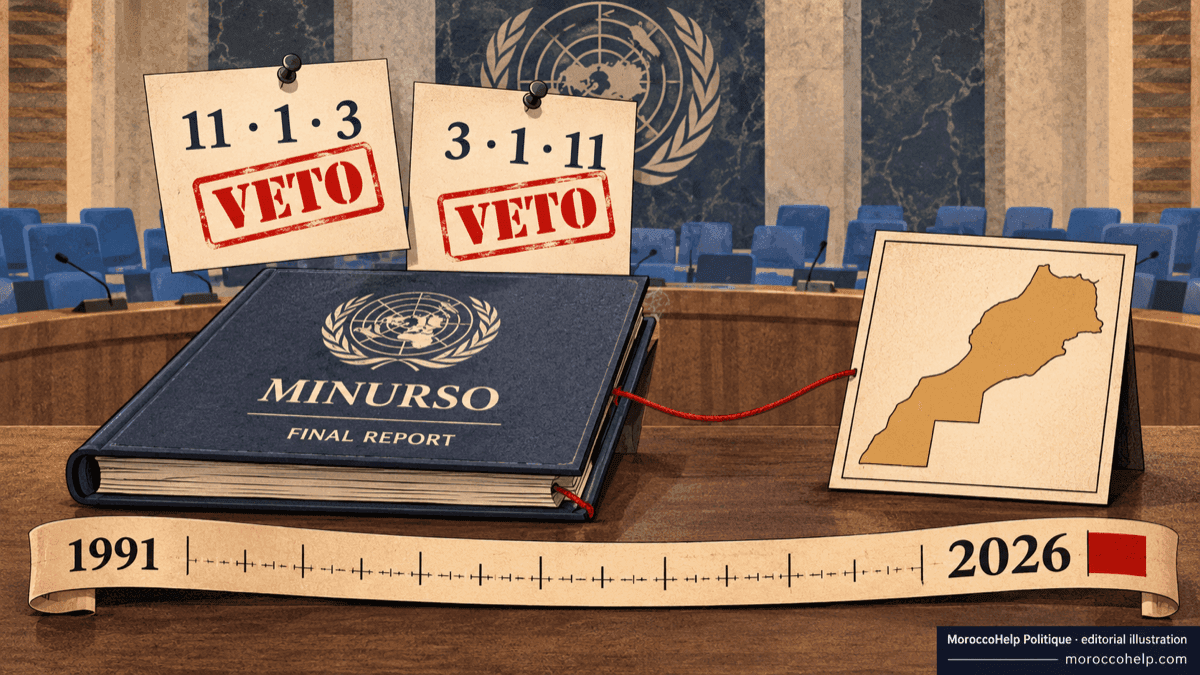
The question this portal posed three days ago - would the Council turn the page or rupture the book - was answered on Friday evening in a way almost nobody had scripted. The Security Council did not reject the American draft and adopt another. It adopted nothing at all. Two rival texts, two vetoes, zero resolutions. And when the day turns, the mandate of MINURSO - the Mission for the Referendum in Western Sahara, born in April 1991 to organize a vote that was never held - expires for the first time in its history without renewal.
How the Council split
The arithmetic of the evening tells the story in four lines. The American draft (document S/2026/868), which would have renamed the mission MINUSO, dropped the word "referendum" from its title and mandate, extended it to 31 October 2027 and written Morocco's autonomy proposal in as the sole basis for negotiations, received 11 votes in favor, 1 against and 3 abstentions. One of the votes against belonged to a permanent member: Russia, and the draft died.
Vasily Nebenzya, Moscow's envoy, told the chamber that final settlement modalities "need to be acceptable, both to the Moroccans and the Polisario Front", and that "the imposition of one-sided solutions" leads "to a dead end". Russia then tabled its own text - a straight one-year renewal of the existing mandate. It fared worse: 3 in favor, 1 against, 11 abstentions, with the United States casting the decisive no. Washington's ambassador Mike Waltz said his country would not "lend our vote to business as usual", nor "to a mission whose very name perpetuates something that cannot be done". He cited three decades of failed referendum efforts and what he called deteriorating humanitarian conditions in the Tindouf camps. Britain, France and allied members criticized the Russian veto, warning of a setback to the talks.
What the Royal Office said
Morocco's answer came within hours, in a Royal Office statement that reads less like a reaction than an inventory of consequences.
The non-renewal, it said, is "a major development and a significant step toward the definitive closure of the Moroccan Sahara issue at the United Nations". It means the mission's presence in the southern provinces - "particularly through its personnel, vehicles, equipment, and symbols - is expected to cease in the coming days". And it closed the ledger with a sentence of historical accounting: "A 35-year chapter has now come to a close", one "rooted in an anachronistic and outdated context", the mission having "long served as a tool for internationalizing the regional dispute".
Three further consequences followed. The non-renewal "should mark the end of the Security Council's consideration of the matter and the removal of this issue from its agenda" - no more periodic meetings, no more Secretary-General reports, no more briefings by the Personal Envoy. The UN political process, "marked by the procrastination of other parties", is "suspended", with "similar actions" promised "shortly within other UN bodies". And Morocco "remains firmly committed to the ceasefire, with strict respect for its territorial integrity, national security, and the tranquility of its citizens".
The statement framed the timing as deliberate: the collapse of the mandate arrives on Unity Day, symbolizing "a break with the previous approach" - "shifting from a mere management logic to an approach aimed at profoundly transforming the parameters".
An orderly drawdown, not a scramble
The exit, however, will be managed, not improvised. Waltz told the Council the United States would work with the UN on exactly that: "Since this vote will result in a drawdown, we need to ensure that it be orderly and stable, that it protects UN personnel and addresses legitimate security and humanitarian needs." He added that Washington's diplomacy continues: "President Trump brought the parties back to the table, alongside the United Nations and the Secretary General's personal envoy. That work should not stop."
The practical questions now belong to UN planners: repatriating military observers and police, disposing of assets, winding down the Laâyoune liaison structure. For the southern provinces, the change is mostly visible - berets, vehicles and flag disappear from the landscape.
From management to transformation
Our preview of the vote set three markers: the count, the explanations of position, the reaction in the camps. The count came in at 11-1-3; the Polisario, which had protested the draft in Tindouf all week, said it would not engage in any process contrary to "the rights of our people". What the preview did not anticipate was Rabat converting a procedural failure into a framework: the file leaves the Security Council's routine and moves, in the Royal Office's language, from management to transformation, carried by bilateral recognition - more than two-thirds of UN member states now back autonomy under sovereignty.
The El Mansouri government inherits the follow-through two weeks after winning investiture: the development budgets for the south, the parliamentary cover, the communications battle. Finance Minister Fouzi Lekjaa, presenting the 2027 bill to Parliament on Friday, told deputies Morocco was nearing "decisive developments" on the dispute. He did not know how soon.
What to watch now
Four sequences will define the weeks ahead: the physical withdrawal calendar in the southern provinces; the promised steps in "other UN bodies", starting with the General Assembly's Fourth Committee, whose 16 October resolution garnered 152 votes; whether the Council formally strikes the item from its agenda; and the reaction from Algiers and the camps to a ceasefire now monitored from one side only.
One era did not merely end this week. It was administratively closed, in a statement issued on the kingdom's newest national holiday.
The government page tracks the cabinet carrying this file; the results archive holds the electoral arithmetic behind it.
Updated on 31 October 2026
- #sahara
- #united nations
- #security council
- #minurso
- #veto
- #diplomacy
Frequently asked questions
Why did MINURSO's mandate end on 31 October 2026?
The Security Council failed to adopt either of two rival drafts on 30 October. The American text, which had 11 votes in favor, was blocked by Russia's veto; the Russian text for a simple one-year renewal received 3 votes in favor, 1 against and 11 abstentions. With no resolution adopted, the mandate created in 1991 simply lapsed at its expiry date.
What did Morocco's Royal Office announce?
That the non-renewal clearly means the mission's presence in the southern provinces, through its personnel, vehicles, equipment and symbols, is expected to cease in the coming days; that the UN political process is suspended; and that similar steps will follow in other UN bodies. Morocco says it remains firmly committed to the ceasefire.
Does the mission's end change Morocco's position?
No. The Royal Office describes the development as a significant step toward the definitive closure of the issue at the UN and says the King's diplomatic momentum continues at the bilateral and regional levels, with more than two-thirds of UN member states supporting autonomy under Moroccan sovereignty as the framework for a solution.